⚔️ Plywood vs OSB (and MDF, LVL) — Choosing the Right Panel
Plywood vs OSB, MDF and LVL: one page that ends the panel argument. What each material actually is, how their strength, moisture behavior, weight, edges and price differ, which panel every roof, wall, floor and cabinet job should use — and where the calculators that size each of those jobs live.
The short answer: plywood vs OSB, per use case
Plywood vs OSB is the wrong question for most projects — the right question is what the panel has to survive. OSB wins the hidden structural jobs on price. Plywood wins wherever moisture, visible edges or screw-holding decide the outcome. MDF owns painted interior work. LVL is the beam you spec when a span outgrows lumber. The short answer, per use case:
OSB — span-rated, cheaper and the industry default; switch to plywood for long bare exposure or heavy-load specs
OSB in dry markets; plywood where the cladding traps moisture and swollen edges would telegraph through siding
T&G plywood or premium sealed OSB — the finished floor punishes edge swell; commodity OSB only under forgiving coverings
Plywood boxes; MDF for painted door panels; particle board only at the ready-to-assemble budget end
3/4″ plywood for typical shelf spans; LVL once the load leaves the 4×8 sheet world entirely
Plywood, always — exterior glue and veneers dry evenly; OSB edges swell and MDF bodies crumble
Are OSB and plywood the same? What OSB, MDF and LVL actually are
Four panels share one lumberyard aisle and almost nothing else. Each is built differently, and each build decides how it fails — so the definitions come first:
Plywood — veneers, cross-laminated
Plywood is the oldest of the four panels and the one every alternative gets measured against. Thin veneers are peeled or sliced from a log, dried, glued into a stack with each layer's grain rotated 90 degrees from the last, and hot-pressed into a sheet. Cross-lamination is the whole trick: it gives plywood near-equal strength in both grain directions, limits the warping a solid board suffers, and lets a thin face veneer carry the appearance grade while cheaper inner plies do the structural work. Softwood construction plywood (CDX and sheathing grades) uses exterior glue and rough C/D faces; sanded and hardwood plywoods trade structure-per-dollar for appearance and clean machined edges.
OSB — strands, pressed and oriented
OSB — oriented strand board — is plywood's industrial answer. Instead of veneers, wafers and strands of fast-growing, low-grade wood are blended with wax and resin, oriented in layers, and pressed into a fully engineered panel with no grain-continuous face at all. The result meets or beats the span ratings of the plywood panels it replaced in structural sheathing, at a lower price, in sheets up to 8×24 feet. The trade-offs appear in moisture: OSB soaks slowly and dries even more slowly, and its cut edges swell noticeably — the two behaviors that dominate the plywood vs OSB decision anywhere water is involved.
MDF — fibers, uniform and non-structural
MDF — medium-density fiberboard — is not a structural panel at all. Wood is broken down to individual fibers, mixed with resin and wax, and pressed into a dead-flat, void-free board of uniform density with no grain and no veneer. That uniformity is the product: MDF machines a glass-smooth painted edge, takes paint better than any other wood panel, and never cups or splinters. What it gives up is everything structural: bending strength is poor, screw-holding is marginal, and water contact swells and crumbles the board permanently. It is an interior paint-grade material, full stop — and the heaviest of the four per cubic foot.
LVL — veneers aligned into beams
LVL — laminated veneer lumber — is plywood's beam-shaped cousin. The same peeled veneers are glued with every grain running the same direction, so the product concentrates strength along its length instead of spreading it across a sheet. LVL is sold as dimensional beams, typically 1-3/4 inches thick and 3-1/2 to 24 inches deep, rather than as 4×8 panels, and it carries the highest bending strength of the four materials here. That is why headers, garage-door openings and long floor beams run LVL wherever doubled 2x lumber runs out of capacity. It is an engineered structural product, not a sheathing or appearance panel.
 Same aisle, different failure modes — the rack run decides the project
The main differences between OSB and plywood, MDF and LVL — side by side
The matrix below compares the four panels on the attributes that actually change a buying decision. Performance values are typical published ranges from APA and PFS-TECO product literature — individual mills, brands and thicknesses land above and below them. Nothing here substitutes for the span rating stamped on a panel or an engineer's call on structural work.
| Material | Strength & stiffness | Moisture response | Edge swelling | Weight | Cost per sheet | Edge quality | Screw-holding | Best use |
|---|---|---|---|---|---|---|---|---|
| Softwood plywood | Strong in both grain directions (typical) | Absorbs and dries evenly; swells as a whole panel | Modest — edges splinter or delaminate if left bare | ~60 lb per 3/4″ 4×8 sheet (typical) | Highest in sheathing grades — see price table | Clean solid edge — routes, sands and shows well | Good in faces; moderate in panel edges | Visible work, wet exposure, screw-hung structures |
| OSB | Meets the same span-rating classes (typical) | Absorbs slowly, dries slowly; holds water longest | High at cut edges — swells and can telegraph | ~75–80 lb per 3/4″ 4×8 sheet (typical, +25–30%) | Lowest structural panel — $5–15 under plywood | Rough, chips, cannot be machined or finished | Good and uniform across the strand matrix | Hidden structural sheathing on a budget |
| MDF | Non-structural — poor bending strength | Worst of the four — swells and crumbles when wet | Very high; every edge must be sealed | ~105–110 lb per 3/4″ 4×8 sheet (typical) | Cheap flat 3/4″ panel — under sanded ply by $20–40 | Glass-smooth machined edge — the paint-grade king | Poor in edges — use threaded inserts | Painted interior millwork, doors, fixed faces |
| LVL | Highest bending strength of the four (typical) | Dimensionally stable; not rated for wet exposure | Minimal swelling; protect from weather in storage | Sold as beams, not sheets — dense per cubic foot | Per linear foot of beam — $7–12 typical at 9-1/4″ | Clean machined edges, uniform throughout | Very good — dense parallel-strand core | Headers, beams, openings wider than lumber runs |
Typical values per APA / PFS-TECO product literature for each panel class — verify against the stamp on the actual panel before structural use. Weights are for a 3/4-inch 4×8 sheet unless noted; LVL is sold by the linear foot as a beam.
Two rows of that matrix explain most of the plywood vs OSB debate on their own. Weight: OSB runs roughly 25–30% heavier than plywood at the same thickness — real money when a crew sheathes a roof by hand, and a real limit on how many sheets a truck bed or a staircase carries. Cost: OSB undercuts plywood in the sheathing grades by $5–15 a sheet, which across a 30-sheet roof is a $150–450 swing — the single reason OSB took the structural sheathing market. To sanity-check what a full order of any of these materials actually weighs, the site's plywood weight calculator already supports OSB and MDF densities alongside hardwood, softwood and marine plywood, so a mixed-material order can be estimated in one pass.
Read every cell as a typical value, not a guarantee: APA and PFS-TECO publish performance ranges per product class, and real panels vary around them. Structural decisions belong to the stamp on the panel — the span rating — and to engineered drawings, never to this table. Grade letters, veneer quality and the rest of the panel family are covered in the plywood types & grades guide.
→ Estimate the full order with the plywood weight calculator — per-sheet and per-order weights in lb or kg, OSB and MDF included.
Plywood vs OSB cost: price per sheet in 2026
Panel prices move with region and season, so the ranges below use the same basis as the rest of the site: US big-box retail, November 2026. Every plywood figure is reused from the price the site verified in its price guide; the OSB, MDF and LVL figures are typical estimates for the same period and retailers. Treat the bands as where a normal rack price falls, not as a quote.
Source for the verified plywood ranges: the site's plywood & lumber price guide, updated November 2026 with its full table and sources.
| Job | Plywood price (verified) | Alternative panel (typical est.) | Typical per-sheet difference |
|---|---|---|---|
| 1/2″ wall sheathing | 1/2″ CDX plywood: $25–40 (verified) | 7/16″ OSB: $15–30 (typical est.) | OSB saves ~$5–15 per sheet |
| 5/8″ roof decking | 5/8″ plywood sheathing / T&G: $30–48 (verified) | 5/8″–23/32″ OSB: $25–40 (typical est.) | OSB saves ~$5–10 per sheet |
| T&G subfloor | 23/32″ T&G Sturd-I-Floor: $38–60 (verified) | 23/32″ T&G OSB: $30–48 (typical est.) | OSB saves ~$8–12 per sheet |
| 3/4″ structural utility | 3/4″ CDX plywood: $35–55 (verified) | 3/4″ OSB: $30–45 (typical est.) | OSB saves ~$5–10 per sheet |
| 3/4″ visible / cabinet grade | 3/4″ sanded ACX / A2 birch: $55–90 (verified) | 3/4″ MDF: $35–55 (typical est.) | MDF saves ~$20–40 — non-structural and ~40% heavier |
| Long spans (per linear ft) | Doubled 2x lumber or plywood web: varies by span | 1-3/4″ × 9-1/4″ LVL: $7–12 per ft (typical est.) | LVL replaces built-up beams above ~6 ft openings |
Plywood rows reuse the price guide's verified November 2026 US big-box retail ranges; OSB, MDF and LVL rows are typical estimates for the same period and retailers and vary by region and season.
The honest reading of that table: in the structural grades the plywood vs OSB cost gap is real but modest — $5 to $15 a sheet — and it buys the OSB order nothing at a wet job site. In the appearance grades the gap flips and explodes: a 3/4-inch sanded plywood sheet costs $20–40 more than MDF of the same thickness, but it is also far lighter, screw-holds properly and can carry shelves and cabinets. MDF's saving only makes sense where the panel is glued into a paint-grade door or a fixed cabinet face and never asked to carry a load.
Premium subfloor OSB narrows the plywood gap from the other side. A sealed-edge premium sheet — the Advantech class — typically runs at or above plywood subfloor money, and that premium buys denser cores, factory-sealed edges and long no-sanding warranty programs whose exact terms vary by brand and product line. Read the manufacturer's current policy before paying the premium, because coverage lengths, exposure limits and site-preparation requirements change, and the warranty is a real part of what the extra dollars purchase.
🧭 Plywood vs OSB, decided in one line: if the panel will ever get wet, show an edge, hold screws or be seen — plywood. If it is hidden structure on a budget — OSB. If it gets painted indoors and carries no load — MDF. If a span outgrows lumber — LVL. Once the material is picked, size the order on the plywood calculator homepage, or browse the full calculator directory for sheathing, subfloor, cabinet, span and weight tools that accept your material choice.
Per-scenario verdicts: which panel each job actually needs
Roof sheathing: why roofers are using OSB instead of plywood
Roof sheathing is where OSB won the market, and the reasons are practical rather than sentimental. A 7/16-inch OSB panel carries the same span-rating class as the 1/2-inch CDX plywood it replaces, costs $5–15 less per sheet, comes in longer lengths that kill hip and ridge laps, and installs flat with no core voids for a fastener to find. Roofers are using OSB instead of plywood because crews laying 30–60 squares a week feel every dollar and every truckload — availability is also better, since OSB mills run closer to full capacity year-round. Plywood takes the roof back in three cases: long bare exposure on a stalled build, where swollen OSB edges will ridge under shingles before they ever land; heavy tile or snow-load specs where the designer calls veneer panels; and partial re-decks where new OSB edges must feather into old plywood. Size either roof, either material, with the calculator below.
Wall sheathing: the benefits of OSB plywood sheathings, and the downfalls to OSB over plywood
Wall sheathing is the friendliest environment OSB ever works in: vertical drainage, covered by wrap and siding within weeks, no foot traffic. The benefits of OSB wall sheathings are the roof's benefits plus racking strength — OSB's shear values are the reason most engineered wall-bracing tables default to it, and its price gap over plywood is widest exactly where walls consume the most sheets. The downfalls to OSB over plywood concentrate at the edges: behind stucco, brick veneer or any cladding that traps moisture, wet OSB edges swell and can telegraph through siding as ridges, and the panel holds water longer after a driving-rain season. In wet-coastal and high-humidity builds, plywood wall sheathing dries faster and keeps its edges through the exposure years; in dry inland markets, OSB is the correct default. Either way, the calculator below handles openings, sheet counts and waste for the material you pick.
Subfloor: the benefits of plywood over Advantech-class OSB
Subfloors are the harshest test a structural panel gets: foot traffic for the whole build, plumbing leaks, and a finish floor of hardwood, vinyl or tile that shows every ridge. This is where the benefits of plywood over Advantech-style premium OSB get argued, and the honest answer is that both survive when the details are right. T&G plywood swells less at edges and dries faster after a leak; premium OSB answers with denser cores, factory-sealed edges and long no-sanding warranties that close most of the gap — at a price at or above plywood subfloor money, with terms that vary by brand and are worth reading before the premium is paid. The failure mode that decides real jobs is edge swell under vinyl plank and tile, where plywood's modest, uniform swelling beats OSB's localized ridges; carpet and floating floors forgive either panel. If the schedule can leave subfloor exposed through a wet season, plywood or premium sealed OSB is the call; for fast, covered schedules, commodity T&G OSB is the value pick. Joist spacing, sheet count and screw layout for any of them: the calculator below.
Cabinets and furniture: are MDF cabinets plywood, or particle board vs real plywood cabinets?
Cabinet work leaves the structural question entirely, and it answers are MDF cabinets plywood with a firm no. MDF is fiber and resin; plywood is veneers and glue; particle board is chips and resin — three different products with three different failure modes. Painted MDF cabinet doors and drawer fronts are excellent: dead-flat, sharp edge detail, flawless paint, which is why paint-grade shops lean on them. MDF boxes exist too, common in European-style cabinetry, but they weigh roughly 40% more than plywood and demand threaded inserts wherever screws land. The particle board vs real plywood cabinets question resolves the same way: melamine-coated particle board dominates ready-to-assemble and apartment-grade boxes on price and flatness, while real plywood cabinets win on screw-holding, moisture tolerance, shelf span per thickness, lighter weight and exposed edges that can be finished. The standard shop hybrid runs plywood boxes with MDF or paint-grade door panels — structure and lightness where the box needs it, dead-flat paint surfaces where they show. Box counts, sheet yield and shelf loads: the calculator below.
Shelf spans and headers: are LVL and plywood different?
The last scenario compares panels against beams, and it settles are LVL and plywood different with same veneers, opposite orientation. Plywood spreads strength across a sheet in two directions, which is exactly what a shelf wants — a 3/4-inch birch-ply shelf carries a heavy row of books across 24–30 inches, and the calculator below sizes those limits by material and thickness. LVL puts every veneer's strength along one axis, which is useless for a shelf but decisive for a header: where a doubled 2×10 runs out of capacity near a 6-foot opening, a single 1-3/4-inch LVL takes over, and beyond roughly 10 feet LVL is the standard answer rather than an upgrade. The crossover point is easy to state. Anything you can cut from a 4×8 sheet is plywood's job — or MDF's, if it gets painted. Anything that has to carry a load across a room is LVL's job, sized by an engineer or the manufacturer's tables. Shelf and load spans for the sheet materials: the calculator below.
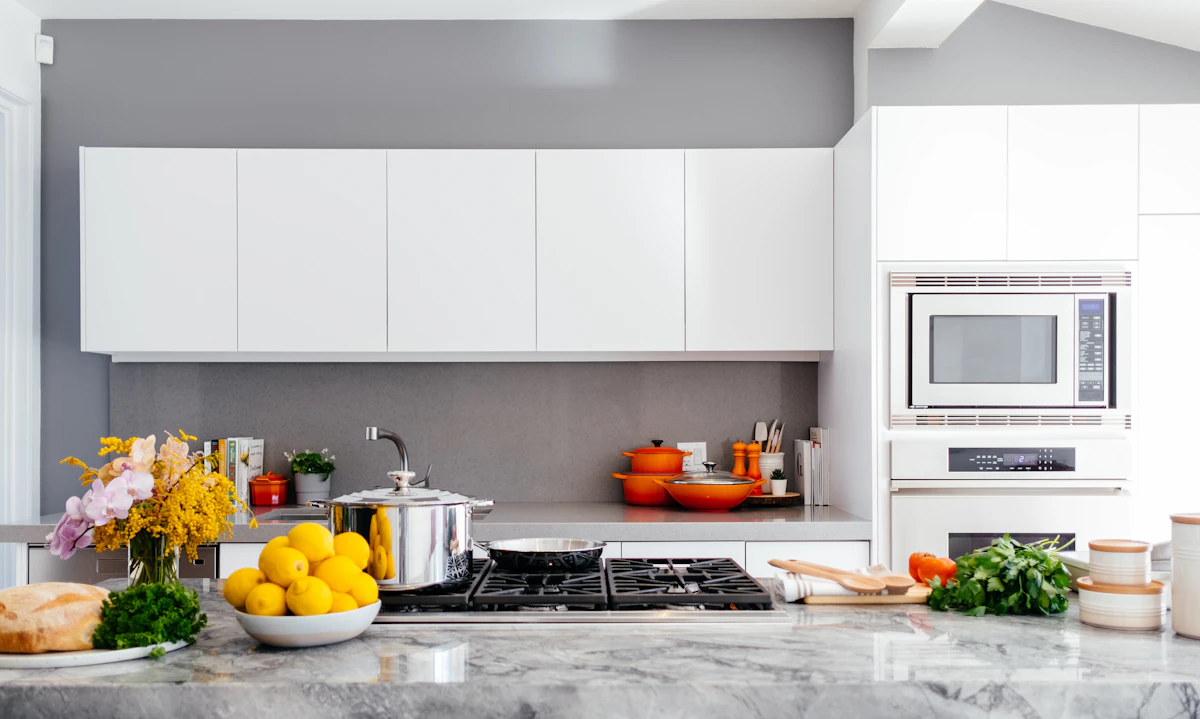 Plywood box, paint-grade door panel — the standard cabinet hybrid
Last updated: November 2026 · Published by the Plywood Calculator team · Performance figures are typical published ranges (APA/PFS-TECO literature); prices are November 2026 US retail estimates — see the price guide for sources.
Plywood vs OSB, MDF and LVL FAQ
Are OSB and plywood the same?
No — they are different products built to solve the same structural job. Plywood is layers of peeled veneer glued with the grain rotated 90 degrees between layers; OSB is compressed strands oriented in layers with resin and wax. At the same thickness and span rating they carry similar loads, but plywood is lighter, dries faster when wet and keeps cleaner edges, while OSB is cheaper, uniform in every sheet and available in longer lengths. Same job category, different materials — which is why the choice is made per project, not per preference.
How are OSB and plywood different — the main differences?
Five differences decide almost every purchase. Price: OSB runs $5–15 less per sheet in the sheathing grades. Moisture: plywood absorbs and dries evenly, while OSB soaks slowly, dries slowly and swells hardest at cut edges. Weight: OSB is about 25–30% heavier at equal thickness. Edges: plywood machines and shows well; OSB edges are rough and swell visibly. Consistency: OSB has no veneer faces, knots or core voids, so every sheet behaves the same, while plywood varies with its face grade. Appearance work defaults to plywood; hidden sheathing defaults to OSB.
What are the specs differences between plywood vs OSB?
On paper the structural specs are close: both carry APA span ratings — the 24/16 or 32/16 stamped on the panel — and equal thicknesses receive similar span classes. Beneath the stamp, the specs differences between plywood vs OSB are that plywood's modulus of elasticity is typically somewhat higher, so it is a touch stiffer at equal thickness; OSB's shear strength and nail-holding are competitive to slightly better; and OSB's density, and therefore its weight, runs about 25–30% higher. That is why queries like specs differences plywood vs OSB resolve at the stamp rather than at the material name: for engineered work the stamped rating governs, and two panels with the same span rating are interchangeable for that use.
Why are roofers using OSB instead of plywood?
Price, availability and sheet length. OSB undercuts plywood by $5–15 per sheet in the sheathing grades, which is a $150–450 saving on a typical 30-square roof; it is stocked in greater volume at most yards; and long OSB sheets, up to 24 feet, let a crew run hips and eaves without a lap. Crews also like that OSB has no core voids, so a fastener never lands in a hidden gap the way it can in cheap plywood. The switch has limits — stalled builds leave OSB edges swollen, and some specs and wet-climate builders still call plywood. Roofers choose OSB because the fleet-scale math favors it, not because it outperforms plywood in moisture.
What are the benefits of OSB plywood sheathings — and the downfalls to OSB over plywood?
The benefits of OSB sheathings: lower cost per sheet, no knots or core voids, uniform stiffness in every panel, larger available sizes, and competitive span ratings and shear values. The downfalls to OSB over plywood: cut edges swell noticeably and can telegraph through flooring or siding; the panel absorbs water slowly and dries slowly, so a soaked roof or wall stays wet longer; it is 25–30% heavier to carry up a ladder; the edges cannot be machined or finished; and long bare exposure during construction is riskier than for plywood. Net: OSB for covered, fast, hidden structural work — plywood for exposure, moisture risk and anything visible.
Which OSB brands are better than plywood — and what are the benefits of plywood over Advantech?
Premium OSB is genuinely excellent at what it does. Advantech-class engineered subfloor panels use dense cores, sealed edges and long no-sanding warranty programs — exact terms vary by brand, so read the current policy — and for subfloor service they outperform commodity OSB outright. But better than plywood is the wrong frame: the benefits of plywood over Advantech-style OSB are faster drying when wet, modest uniform swelling instead of localized edge ridges, lower weight, machinable show edges and a lower price. Premium OSB competes at the top of the subfloor market, not as a universal replacement — the two products are optimized for different failure modes.
Are MDF and plywood the same? What are the properties of MDF and plywood?
No — MDF and plywood are different materials built at the same press. The properties of MDF: a uniform fiber-and-resin core with no grain, dead flat, machines a glass-smooth edge, takes paint better than any wood panel — but it is non-structural, screw-holds poorly in edges, weighs roughly 40% more than plywood at equal thickness, and crumbles permanently if soaked. The properties of plywood: cross-laminated veneers that are strong in both directions, light for their strength, good screw-holding, available in appearance grades with real wood faces — but cheaper cores can contain voids and faces can splinter. Paint-grade interior work favors MDF; structural, moisture-exposed or clear-finished work favors plywood.
Are MDF cabinets plywood — and how does particle board compare to real plywood cabinets?
MDF cabinets are not plywood. MDF is wood fiber and resin, plywood is glued veneers, and they fail differently. Painted MDF doors and drawer fronts are excellent — flat, crisp edges, flawless paint — while MDF boxes are heavy and need threaded inserts where screws land. On the particle board vs real plywood cabinets question: melamine-coated particle board dominates budget and ready-to-assemble boxes on price and flatness, while real plywood cabinets win on screw-holding, moisture tolerance, shelf span per thickness, weight — plywood is much lighter — and exposed edges that can be finished. Most custom shops build plywood boxes with MDF or paint-grade door panels: structure and lightness in the box, dead-flat paint surfaces where they show.
Is there a difference between LVL and plywood?
Yes — searches like are LVL and plywood difference, or is LVL stronger than plywood, all land on the same answer: the same raw material with the opposite grain strategy. LVL glues peeled veneers with every grain running the same direction, concentrating bending strength along the beam's length; plywood rotates each layer 90 degrees, spreading strength across a sheet. That makes LVL the strongest of the four panels in bending per pound, but only along its axis — it cannot serve as sheathing, shelving or a finished panel. LVL is sold as beams, typically 1-3/4 inches thick and 3-1/2 to 24 inches deep, priced per linear foot, for headers, floor beams and long openings. So, are LVL and plywood different — completely, and by design: each is the best in the family at a job the other cannot do.
What are the differences between plywood and composite panels in general?
Plywood is veneer-based: real wood layers, visible grain, a face grade you can select, and behavior that tracks solid wood — it moves with humidity, takes screws well and can be refinished. Composite panels — OSB, MDF and particle board — are strand- or fiber-based: resin-bound, grain-free, extremely uniform, and typically cheaper per panel. The practical differences between plywood and composite panels show up in four places: composites swell worse at edges when wet; composites are heavier at equal thickness, with MDF the worst at roughly 40% more; composites cannot be machined into a show edge — MDF paints beautifully but never stains or exposes grain; and plywood is the only one of the four with appearance grades. Choose composites for uniformity and price, plywood for moisture, fastening and looks.
Related Guides & Resources
Plywood Weight Calculator
Estimate plywood sheet weight by thickness and material type — hardwood, softwood, MDF, OSB. Per-sheet and total weight in lbs or kg.
Fastener & Screw Calculator
Calculate screws or nails for subfloor, wall, roof, or cabinet plywood. IRC-standard edge/field spacings plus box purchase recommendations.
Multi-Room Plywood Calculator
Add unlimited rooms, walls, and ceilings in one calculation. Per-area square footage, combined total, and unified plywood sheet count.
Edge Banding & Seam Tape Calculator
Calculate edge banding and roof seam tape length for any plywood order. Feet or meters, 0-4 banded edges, roll recommendations included.
Plywood Cut Calculator
Visual 2D plywood cut layout. Compare along-length vs along-width cuts, add saw kerf width, and see full sheets vs the last cut sheet with exact waste.
Roof Sheathing Calculator
Roof sheathing sheets from footprint, pitch, and roof type. Pitch multiplier, squares, gable vs hip waste factor, and thickness by rafter spacing.
Subfloor Calculator
Subfloor sheets for any room with joist spacing, T&G thickness, and a 12% seam-break waste. Underlayment layer and layout direction included.
Wall Sheathing Calculator
Wall sheathing sheets with door and window deductions. Net vs rough sheathing modes, stud spacing thickness, and APA shear wall capacity reference.
Cabinet Plywood Calculator
Cabinet plywood by parts list — wardrobe, shelves, drawers, backs. Sheets grouped by thickness, 4×8 or 5×5 Baltic birch, MDF weight comparison.
Aquarium Plywood Calculator
Plywood aquarium builder: water volume and weight, plywood sheets for tank panels, and glass or acrylic front thickness by water depth.
Plywood Span Calculator
Shelf sag, point load, and floor load deflection for plywood. E by material, L/360 and shelf limits, APA span ratings, and OK/sag-risk verdicts.
Plywood CBM Calculator
Convert plywood sheets to CBM for freight — per-sheet cubic meters, total volume with pallet allowance, and how many sheets load a 40HQ or 20GP.
Kerf Bending Calculator
Calculate kerf spacing, groove count, and cut depth to bend plywood into arcs and circles. Min radius guide and bending alternatives included.
Board Foot Calculator
Calculate board feet for lumber and plywood — single pieces or cut lists, price per bd ft, weight by species, and board-foot to square-foot conversion.
Linear Feet Calculator
Convert square feet to linear feet and back for any material width — flooring, decking, trim, edge banding. Linear yards and waste factor included.
Inch Fraction Calculator
Convert decimal inches to fractions and millimeters instantly — 0.375, 0.625, 0.875 and any value to the nearest 1/64, with tape measure marks.
Cut List Calculator
Nest a labeled parts list onto the fewest plywood sheets — kerf, grain direction, per-sheet nesting diagrams, waste % and a printable cut sheet.
Plywood Sheet Sizes Chart — 4×8, 8×4, 5×5 & Metric
Every standard plywood sheet size by region — 4×8 ft, 4×9, 4×10, 1220×2440 mm, and 5×5 Baltic birch — with square footage per sheet and selection guidance.
Lumber Dimensions Chart — Nominal vs Actual Sizes
Every dimensional lumber nominal size mapped to its actual dressed size in inches and millimeters, standard lengths from 8 to 20 feet, the 4/4–8/4 thickness system, and stud sizes explained.
Plywood Types & Grades Explained — CDX, ACX, BCX, Marine & More
Every plywood grade letter (N/A/B/C/D), the specialized types (CDX, ACX, marine, MDO, phenolic, T&G, pressure treated), species face options, span rating stamps, and a pick-the-right-sheet matrix for outdoor, cabinet, floor and wall projects.
Plywood & Lumber Prices — Sheet Cost by Thickness and Type
What a 4×8 plywood sheet costs by thickness and grade, lumber prices for 2x4s through 4x4s, hardwood per board foot, what drives price swings, seven ways to pay less, and a project cost estimating sequence.
Plywood Walls Guide — Interior Wall & Ceiling Paneling
Plywood walls done right: thickness and grade per scenario, seam layout and gap treatment, screw spacing into studs or furring, stain and paint finishing, ceiling paneling, and real project costs.